
Egypt visa on arrival: the airport QR code since September 2026

The visa on arrival is described in one section of the Embassy’s visa page, updated in September 2026. It opens with a recommendation: visa applicants, except some listed nationalities, should get their visa in advance from the Egyptian consulate that serves their state of residence.
For people who still plan to get the visa at the airport, the page sets conditions. None of them is a fee: the Embassy does not publish what the visa on arrival costs, so this guide does not quote one.
The Embassy’s conditions
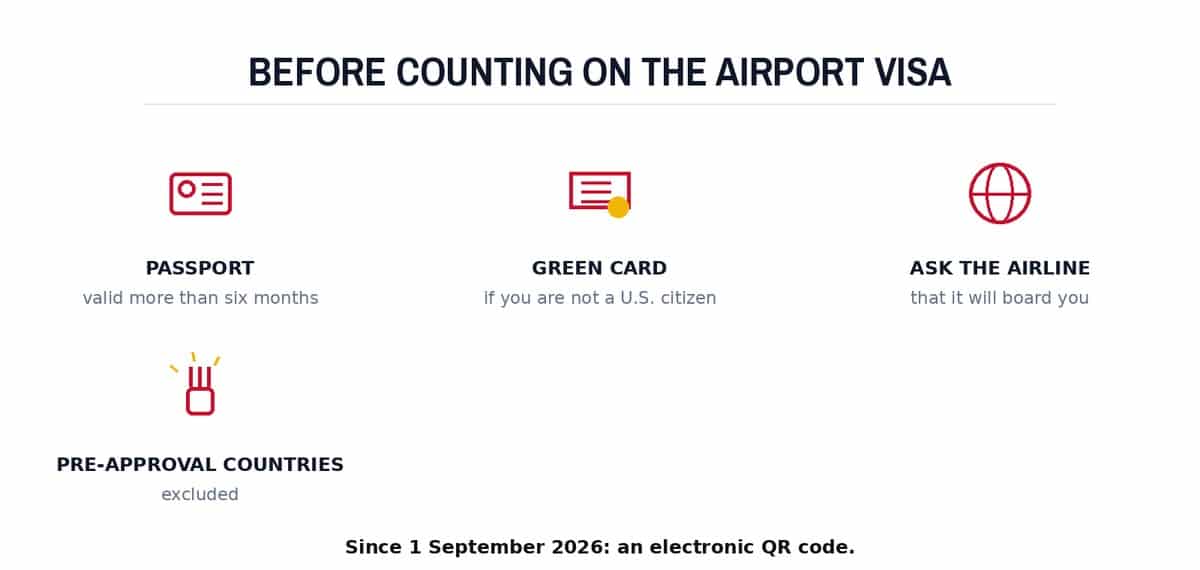
The Embassy lists four things to check before you rely on a visa at the airport. Two are about documents, one is about the airline and one about who is excluded.
| Condition | What the Embassy says |
|---|---|
| Passport | Valid more than six months at arrival |
| Green card, for U.S. residents | Valid more than six months |
| The airline | Confirm that it will board you without a visa |
| Pre-approval nationalities | Cannot get a visa on arrival |
The page adds two warnings: Bangladeshi nationals need a visa before entry, and Egyptian customs have the right to deny entry at the airport if necessary.
New procedure guides, by email
We’ll email you when we publish a new procedure guide. No ads, and you can unsubscribe at any time.
The QR code since September 2026
The Embassy’s note is short: effective 1 September 2026, all Egyptian airports have moved from the traditional visa-on-arrival sticker to an electronic QR code. It does not describe how the code is issued or paid for at the airport, so ask your airline what it needs to see before you board.
The same section keeps the conditions listed above, so the change is in the format of the visa, not in who can get one.
- A passport valid more than six months on arrival
- A green card valid more than six months, if you are not a U.S. citizen
- Your airline’s confirmation that you can board without a visa
- A plan B: the e-Visa or a consular visa
Residents who are not U.S. citizens
The conditions apply to everyone who plans to get the visa at the airport. For green card holders the Embassy adds that the card itself must be valid more than six months.
Some nationalities need a pre-approval from Egypt, and for them the airport is not an option at all; the Embassy says that stage takes six to eight weeks at least.
| Route | When to start | Fee published |
|---|---|---|
| e-Visa | At least seven days before the flight | $30 or $65 |
| Consular visa | At least ten business days at the Embassy | $32 or $67 |
| Visa on arrival | At the airport | Not published by the Embassy |
The alternatives the Embassy points to
The e-Visa is the online route for tourism: $30 for a single entry or $65 for multiple entries, applied for at least seven days before departure (e-Visa FAQ). The consular visa is the route the Embassy recommends for travelers who live in the U.S.: $32 for a single tourist entry at the counter (Embassy visa page).
Why the Embassy calls it an emergency route
The page does not explain the word, but its conditions show the risk: the airline decides whether you board, and customs can refuse entry at arrival. An e-Visa or a consular visa settles the question before the flight, which is why both appear first on the Embassy’s list of routes.
Since 1 September 2026, the visa on arrival is an electronic QR code, not a sticker, according to the Embassy.